
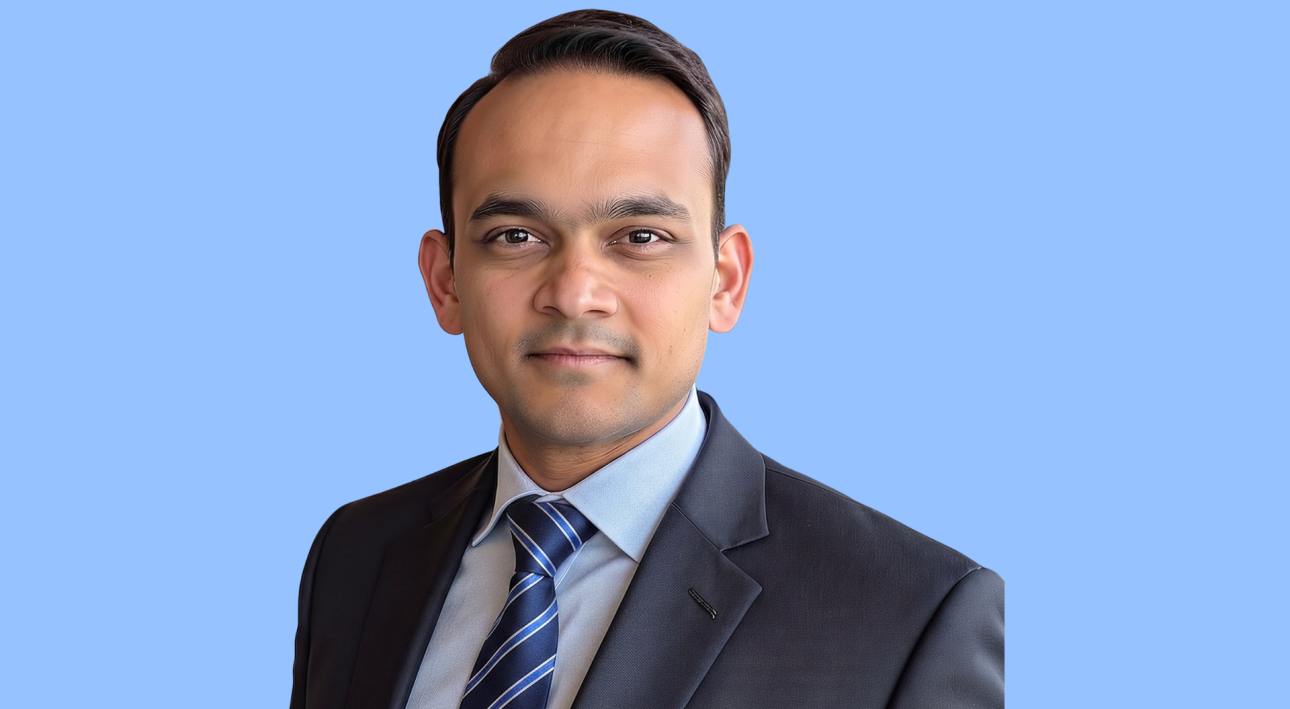
Q&A with Sharp CTO Nakul Subramaniyan
Sharp recently welcomed Nakul Subramaniyan as Chief Technology Officer. With experience across pharmaceutical manufacturing, digital manufacturing & enterprise technology, and digital transformation, Nakul brings a practical, operator-led perspective on how technology can strengthen regulated pharma operations while protecting quality, compliance, security, and customer trust. We sat down with him to discuss what drew him to Sharp, how he thinks about digital modernization, and where he sees the industry heading.
Q: You joined Sharp at an exciting time in its growth. What attracted you to this role?
A few things stood out to me. Sharp has a long heritage in pharmaceutical packaging, and its services offering has become broader and more diversified over time. Sharp plays an important role in a value chain where reliability, quality, and trust really matter. That gives the technology agenda a very clear purpose. We are not talking about technology in the abstract. We are talking about capabilities that can help teams do their work more effectively, help customers have confidence in the services they receive, and ultimately support the patients this industry serves.
I was also attracted to the practical nature of the opportunity. Sharp has established strong expertise across all facets of the business, and this next chapter of growth is about connecting people, process, data, and technology in ways that help the organization scale with discipline. That is the kind of work I enjoy: close to the business, connected to customers, and grounded in outcomes.
Q: Many organizations are talking about digital transformation. What does that actually mean in a regulated pharmaceutical manufacturing environment?
For me, digital transformation is not about implementing technology for technology’s sake. In regulated life sciences environments like ours, any change we propose to make has to respect quality, compliance, security, validation thinking, data integrity, and the realities of the work people do every day.
The most valuable digital work is often very practical. It gives teams better information. It makes workflows more consistent. It reduces unnecessary friction. It offers transparency so that leaders see what is happening sooner and can make better decisions as a result. The measure of success is not how many tools you deploy. It is whether people can do their work with more consistency and reliability, whether customers experience better service, and whether the business becomes more resilient and scalable.
Q: How do you balance innovation with the need for security, compliance and validation?
I do not see innovation and control as opposites. In a regulated environment, employing the right controls is precisely what allows innovation to scale responsibly. Technology has to earn trust in the way it is designed, governed, secured, validated, and adopted by the business.
The starting point should always focus on the problem we are trying to solve and the value we are trying to create. From there, we can ask the right questions: What data is involved? What risk does this introduce? What oversight is needed? How will people use it? How do we make sure it is secure, reliable, and fit for purpose? That disciplined approach does not slow progress down. It helps make progress sustainable for the longer term.
Q: Artificial intelligence is generating enormous interest across healthcare. Where do you see the greatest opportunity in pharmaceutical manufacturing?
AI has real potential, but only when it is grounded in trusted data, clear processes, human oversight, and strong governance. I am most interested in AI as a decision-support and workflow tool, not as a replacement for accountability or expert judgment.
In life science operations, there are practical opportunities to use AI to help people find information faster, identify patterns earlier, support planning, improve document-heavy workflows, and surface insights that would otherwise take longer to see. The value is not that AI is exciting on its own. The value is whether it helps qualified people make better decisions, reduces repetitive work, and improves the reliability and responsiveness of the processes they work to.
Q: Cybersecurity has become a board-level conversation in pharmaceutical manufacturing. How do you think about resilience and “secure by design” at Sharp?
Cybersecurity is no longer just an IT topic. It is a business continuity imperative, a customer trust topic, and, in life sciences, it is connected to the reliability of the broader value chain. As operations become more connected and the supply chain more inter-dependent, security has to be part of the design from the beginning.
“Secure by design” means thinking about identity, access, data protection, monitoring, vendor risk, recovery, and resilience as core requirements, not afterthoughts. It also means cultivating a culture across Sharp where security is understood to be everyone’s responsibility. Customers trust Sharp to operate with care and discipline. Protecting that trust is a central part of technology leadership.
Q: What are the highest-leverage technology investments a CDMO can make right now?
The highest-leverage investments are often the least visible or flashy. Trusted data, connected workflows, scalable platforms, cybersecurity, and practical analytics can create enormous value because they improve how the business operates every day.
Many organizations have deep technical expertise but still have opportunities to make information flow more consistently across teams and processes. When data is easier to trust and workflows are more connected, teams can respond faster, customers get clearer visibility, and leaders can make better decisions. That foundation is also essential to fully leveraging AI, because AI is only as useful as the data, process, and governance ecosystem around it.
Q: What role does technology play in improving customer and patient outcomes?
Technology is often perceived as an internal capability, but customers feel the benefits when it improves reliability, transparency, responsiveness, and execution. Better digital capability can help Sharp teams coordinate more effectively, see risks earlier, communicate with more confidence, and provide customers with clearer visibility as work moves through the business. That kind of transparency strengthens customer partnerships and builds trust.
Quality is central to Sharp’s work, and technology has an important role to play in supporting it. Well-designed digital systems can make information easier to find, workflows easier to follow, and issues easier to identify and resolve. They do not replace the expertise and judgment of Sharp’s teams; they support it. In life sciences, when quality, reliability, and trust are strengthened across the value chain, that ultimately matters for patients. That is what gives this work purpose.
Q: You have used the word pragmatism a few times. Why is that such an important part of your technology philosophy?
Because in regulated environments, technology has to work in the real world. Pragmatism does not mean being slow or cautious for its own sake. It means being clear about the problem, honest about the operating context, thoughtful about risk, and focused on adoption as much as implementation.
I have seen the difference between technology programs that look impressive on paper and capabilities that actually improve the business. The second one requires listening to the people closest to the work, choosing the right priorities, and building trust step by step. Pragmatism keeps the focus on outcomes and the impact, rather than activity. It is how you make modernization credible.
Q: Looking three to five years out, what will the modern pharma manufacturing environment look like, and how is Sharp preparing today?
I think the next several years will bring life sciences operations that are more connected, more data-driven, more secure, and more adaptive. Teams will expect better real-time visibility. Customers will expect clearer information and faster response. AI and advanced analytics will become more embedded in everyday workflows, but human accountability, quality, compliance, and security will remain essential.
For Sharp, the opportunity is to continue build the technical foundations that make that future practical: trusted data, scalable platforms, resilient infrastructure, strong governance, and teams that understand both the technology and the regulated operating environment. The companies that succeed will not simply be the ones that adopt the most technology. They will be the ones that adopt the right technology, in the right sequence, for the right reasons. That is the path I am excited to help build.